
Table of Contents
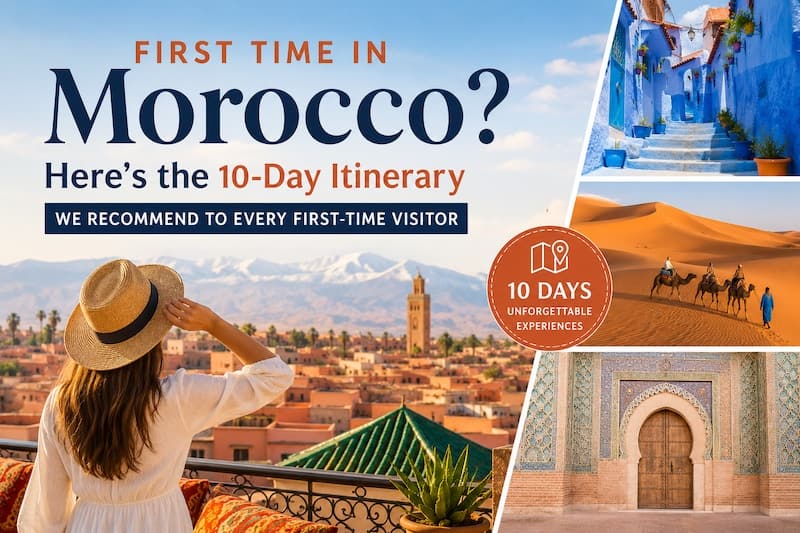
First Time in Morocco? Here’s the 10-Day Itinerary We Recommend to Every First-Time Visitor
Morocco is not the kind of country you fully understand in a single visit.
Every region has its own atmosphere, traditions, food, landscapes, and rhythm of life. In one trip, you can go from the Atlantic coast to the Sahara Desert, from blue mountain villages to centuries-old imperial cities filled with life at every corner.
And for first-time visitors, that’s exactly what makes Morocco so unforgettable.
As Moroccans, we often see travelers trying to do too much in too little time. They rush from city to city, spend more time in transportation than actually enjoying the places they came to see, and leave feeling exhausted instead of connected to the country.
This itinerary is different.
It’s designed to help you experience the Morocco we know and love — at a more realistic pace. You’ll discover iconic destinations, but also moments that truly define traveling here: drinking mint tea on a rooftop at sunset, hearing the call to prayer echo through ancient medinas, sharing fresh bread with locals, and watching the landscape slowly change as you cross the country.
If this is your first time in Morocco, this is the route we would genuinely recommend.
Morocco 10-Day Itinerary Overview
| Day | Destination |
|---|---|
| 1 | Casablanca |
| 2-3 | Chefchaouen |
| 4 | Fes |
| 5-6 | Sahara Desert |
| 7-8 | Marrakech |
| 9 | Essaouira |
| 10 | Departure |
Day 1 — Arrive in Casablanca
Casablanca is usually where most international travelers first arrive in Morocco.
Contrary to what many visitors expect, Casablanca is not the “traditional postcard Morocco” seen on social media. It is Morocco’s economic capital: modern, busy, energetic, and constantly moving.
And honestly, that’s part of its charm.
It shows you the Morocco people actually live in every day.
Visit Hassan II Mosque
No matter how many photos you’ve seen online, Hassan II Mosque is still breathtaking in person.
Built directly above the Atlantic Ocean, it is one of the largest mosques in the world and one of the greatest examples of Moroccan craftsmanship.
The details matter here:
- hand-carved cedar wood
- traditional zellige tiles
- marble floors
- intricate plaster work made by Moroccan artisans
For us, this mosque represents more than architecture. It reflects Morocco’s ability to preserve traditional craftsmanship while embracing modernity.
If possible, visit near sunset when the ocean light becomes softer and the atmosphere feels even more special.
Spend the Evening by the Ocean
After your flight, don’t overplan your first day.
Walk along the Corniche, enjoy fresh seafood, and take your time adjusting to the rhythm of Morocco.
One thing many travelers discover quickly here is that Morocco is best enjoyed slowly.
Day 2 — Travel North to Chefchaouen
Chefchaouen is one of the most unique towns in Morocco.
Hidden in the Rif Mountains, Chefchaouen is famous for its blue-painted streets, relaxed atmosphere, and mountain scenery. But beyond the photos, what visitors usually remember most is the feeling of calm the city offers.
Compared to larger cities like Marrakech or Fes, life here moves more slowly.
Get Lost in the Blue Medina
Our advice?
Don’t follow a strict map here.
The best way to experience Chefchaouen is simply by wandering through its small streets and staircases without rushing.
Early mornings are especially beautiful. Before the crowds arrive, the blue alleyways are quiet, local shop owners are opening their stores, and the mountain air still feels cool and fresh.
It’s one of the few places in Morocco where travelers naturally slow down.
Sunset at the Spanish Mosque
The short walk to the Spanish Mosque offers one of the best panoramic views in northern Morocco.
As the sun goes down over the mountains and the evening call to prayer begins, you’ll understand why so many visitors fall in love with this town.
Day 3 — Slow Down and Experience Local Life
Many itineraries only spend one night in Chefchaouen.
We honestly think that’s a mistake.
Morocco is not only about sightseeing. It’s also about atmosphere, conversations, food, and daily life.
Use this extra day to:
- enjoy a traditional Moroccan breakfast
- drink mint tea in the medina
- shop for handmade textiles
- speak with local artisans
- photograph the quiet streets early in the morning
Sometimes the best travel memories are the simplest ones.
Day 4 — Discover the Soul of Morocco in Fes
Fes is often described as the spiritual and cultural heart of Morocco.
And honestly, nowhere else in the country feels quite like it.
Fes is ancient, intense, and deeply authentic. The city has preserved traditions, crafts, and ways of life that have existed for centuries.
Explore Fes el-Bali
Fes el Bali is one of the oldest and largest medinas in the world.
Inside, you’ll find:
- traditional bakeries
- leather workshops
- craftsmen making ceramics by hand
- narrow alleyways filled with daily life
Unlike many tourist destinations around the world, this medina is not a “museum.” People genuinely live and work here.
That’s what makes Fes so special.
Visit the Chouara Tanneries
Chouara Tannery is one of the city’s most famous landmarks.
Yes, the smell is strong.
Yes, it can feel chaotic.
But seeing leather dyed using traditional methods that have existed for generations is part of understanding Morocco’s artisanal heritage.
A Local Tip
Many first-time visitors feel overwhelmed in Fes at first.
That’s completely normal.
Instead of trying to control everything, allow yourself to get a little lost. Some of the best moments in Fes happen unexpectedly.
Day 5 — The Journey Toward the Sahara
This is one of the longest travel days of the itinerary, but also one of the most beautiful.
What surprises many visitors is how dramatically Morocco’s landscapes change within a few hours.
You’ll leave behind historic cities and eventually cross:
- cedar forests
- mountain roads
- valleys filled with palm trees
- rocky desert landscapes
By the time you reach Merzouga, Morocco feels completely different again.
Stop in Ifrane
Ifrane is often called the “Switzerland of Morocco.”
With its alpine-style architecture and cooler climate, many visitors are surprised by how different it looks from the Morocco they imagined.
That contrast is part of what makes traveling across Morocco so fascinating.
Day 6 — Experience the Sahara Desert
For many travelers, this becomes the highlight of their entire trip.
The dunes of Erg Chebbi are exactly what people imagine when dreaming about the Sahara Desert: endless golden sand, silence, sunsets, and star-filled skies.
Camel Trekking at Sunset
Yes, it’s popular with tourists.
And yes, it’s still absolutely worth doing.
Watching the sun slowly disappear behind the dunes while crossing the desert on camelback is one of those experiences that stays with people long after they leave Morocco.
Spend the Night in a Desert Camp
At night, the atmosphere becomes magical.
Without city lights, the stars appear incredibly bright. Around the fire, local musicians often play traditional Amazigh rhythms while guests share tea and stories under the desert sky.
Moments like this are difficult to explain until you experience them yourself.
Day 7 — Through the Atlas Mountains to Marrakech
The drive toward Marrakech passes through some of Morocco’s most spectacular scenery.
Along the way, we strongly recommend stopping at Aït Benhaddou.
This ancient fortified village is one of Morocco’s most famous historical sites and has appeared in many international films and series.
But beyond Hollywood, places like Aït Benhaddou represent an important part of southern Moroccan heritage and architecture.
Day 8 — Experience the Energy of Marrakech
Marrakech is intense.
Even for Moroccans from other regions, the city has its own energy and personality.
Some travelers fall in love with it immediately.
Others need time.
But almost nobody forgets it.
Discover Jemaa el-Fnaa
Jemaa el-Fnaa is not just a square — it’s an experience.
At night, the atmosphere becomes electric:
- food stalls fill the square
- musicians perform
- smoke rises from grills
- people gather everywhere
It can feel overwhelming at first, but this energy is part of Marrakech’s identity.
Escape the Noise at Majorelle Garden
After hours inside the medina, Majorelle Garden offers a quieter side of the city.
The gardens, exotic plants, and iconic blue colors create a peaceful contrast to the busy streets outside.
Day 9 — Relax in Essaouira
After the intensity of Marrakech, Essaouira feels calm and refreshing.
This Atlantic coastal town is known for:
- fresh seafood
- ocean views
- artistic atmosphere
- white-and-blue architecture
- laid-back lifestyle
The sea breeze alone feels different after several days inland.
Eat Fresh Seafood by the Port
One of the best things to do in Essaouira is simple:
choose fresh fish from the market and have it grilled nearby.
Fresh bread, grilled seafood, ocean air — sometimes Morocco is at its best in these simple moments.
Walk Along the Ramparts at Sunset
Essaouira sunsets have a peaceful atmosphere that contrasts beautifully with the energy of Marrakech and Fes.
It’s the perfect final stop before leaving Morocco.
Day 10 — Leaving Morocco
Most first-time visitors leave Morocco with mixed feelings.
A little tired.
A little overwhelmed.
But already wanting to return.
Because Morocco is not a country you simply “check off” a list.
It’s a place of contrasts:
modern and traditional,
chaotic and peaceful,
mountainous and coastal,
African, Arab, Amazigh, Mediterranean, and Atlantic all at once.
And usually, once people experience it for themselves, they understand why so many travelers keep coming back.